How AI Startups Screen Out 99.9% of ML Applicants Before Spending a Single Recruiter Hour
A four-layer screening stack decides who reaches a human.
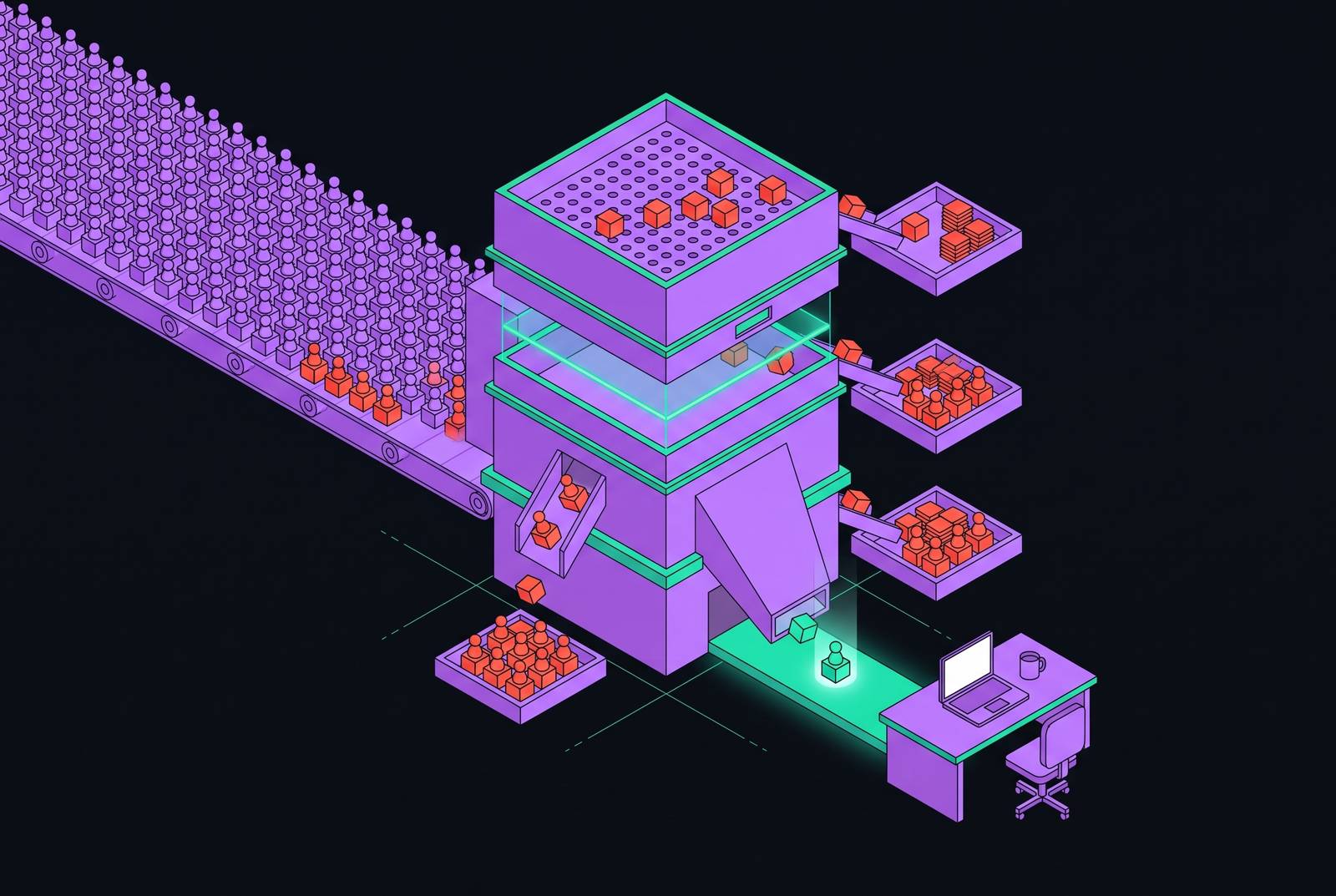
AI startups screen ML applicants through layers that rank claims, gather outside signals, and test technical judgment before a recruiter commits time. Getting through requires evidence suited to each layer. For strong engineers, the better entry route is often public work and referrals that let a founder find them before they apply.
Why ML applicants face a structural filtering problem, not just a competitive one
The screening gauntlet is a deliberate design choice. Candidates can use AI to tailor resumes in seconds and apply to dozens of roles in an afternoon. Across major job platforms, this adds up to 11,000 AI-assisted resume submissions per minute. When those resumes mirror the same requirements, keyword matching no longer separates engineering depth from skill at writing an application.
Startups respond by adding filters that look for different kinds of evidence. Recruiters use agents to rank while candidates use agents to apply, leaving AI to screen AI at the entrance. More people want the same job, and the first document a company receives has become less useful for deciding who can do it.
How the screening stack is actually assembled, layer by layer
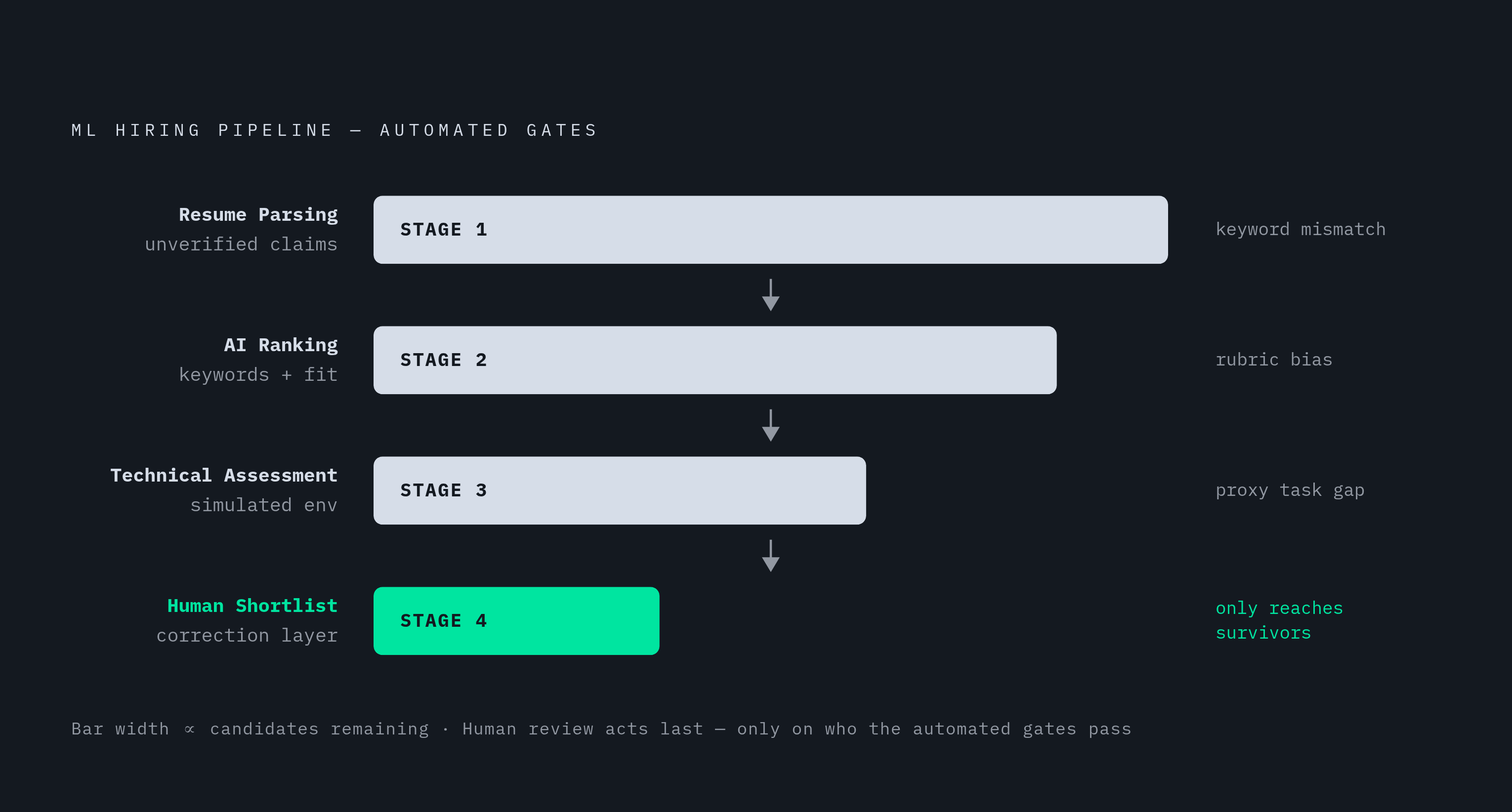
Stage 1 is resume parsing. Modern parsers extract skills, experience, and education, then score them against the job description in seconds. They rank unverified claims. A list of tools gives this layer less useful material than a clear account of what shipped and what it achieved. Passive language, generic projects, and a work history with no legible direction can cause an early exit.
Stage 2 adds AI ranking and enrichment. An agent turns the job description into an internal scoring rubric and ranks candidates on keywords, inferred skills, career trajectory, and role fit. More capable agents also draw on past successful hires and adapt to a recruiter's judgment patterns. The ranked list's order reflects how the search was described, which may differ from what the role actually needs.
That gap is why someone who understands the role still needs to review the top of the ranking before contact. Code repositories, papers, and deployable work give enrichment tools more to look at than the application alone. They cannot make a search accurate if it asks for the wrong things. A precise score can still answer the wrong question.
Stage 3 creates evidence through a sandboxed technical assessment. The more sophisticated screens place candidates in a simulated production environment with a broken or misbehaving agent and ask them to diagnose it. In biotech AI, the distinguishing signal may instead be whether the candidate asks how the data was generated before proposing a model.
Stage 4 is human shortlist review. Its purpose is to catch talent the automated layers miss, especially people with unusual paths or expertise they have understated. Under the recommended model, scores can move candidates forward automatically but can never reject them automatically. Candidates in the middle band go to a recruiter with the evidence shown, while a person reviews a sample of bottom-band rejections every week. Human judgment is a correction mechanism.
What the YC S26 technical screen is actually testing — and why it's different from a LeetCode round
At lean S26-era AI startups, sandboxed agent debugging has become the main technical screen because the work calls for a particular way of thinking. Teams that can compete rely on a few senior operators who run fleets of AI agents. Their next hire must configure and audit agents and get them working again when their behavior breaks. Algorithm recall is not enough for that job.
An infinite execution loop can use up a token budget, while hostile inputs can cause prompt injection and privilege escalation. Silent schema drift presents a different problem, with agents writing data in outdated formats that go unnoticed for weeks. These are failures of production behavior. Knowing syntax or remembering an algorithm does not explain why the agent got into the wrong state or what changed before it failed.
Strong candidates begin by establishing what the agent was supposed to do, what state it was in, and what changed. They reason before they edit. That sequence shows whether they see a system with dependencies and failure modes or merely a piece of code to patch. LeetCode-style preparation does not transfer to this task in the way shipping and debugging production agents does. The screen is built to reveal the difference.
The biotech variant tests the same order of thought. Before choosing an architecture, the candidate needs to understand how the data was generated and what the assay readout means. Going straight to “I'd try a transformer” skips the question the screen is designed to test. The domain changes, but the principle does not. A model choice is useful only after the candidate understands the problem it is meant to solve.
Where the screening stack systematically eliminates strong candidates it should keep
Title matching creates a predictable false-negative path at the first layer. A candidate may have done the work the job calls for without having the title the parser expects. “Member of Technical Staff” is the clearest example in the notes, because the title alone does not say which engineering responsibilities the person held. The work can fit while the label does not. An early filter may reject the candidate before anyone examines that distinction.
Keyword saturation creates a separate failure at the same entrance. When applicants use AI to add every expected term, a match says less about how much they know about the technical work. Stronger screening is a reasonable response to overstated proficiency. But it also catches underdeclared experts who describe what they did without showing how well they did it.
The ranking layer can make these errors worse. A rubric built around one kind of career path may struggle to score someone who gained their skills through an unusual route. Human review exists partly to recover that signal. If rejection happens before review, the corrective layer never gets the evidence it needs. The system has removed the very candidate its final stage was meant to recognize.
There is also a cost outside the scoring rubric. Strong candidates with other options can leave a process they consider broken or opaque. When they leave, they change who is left to assess, even if every later assessment is well designed. This is the strongest objection to unchecked automated rejection. A system can become more selective while getting worse at finding the people the company wants.
How to present yourself so each screening layer passes you forward
For candidates navigating this system, the practical response is to prepare for each layer separately. At the parsing stage, lead with outcomes rather than tool names, using active descriptions of what shipped and what it did. Make the work legible on the page. If your actual title differs from the role's label, add a brief clarification of your responsibilities rather than assuming a person will infer the connection. Explain the substance while keeping your actual title.
At the ranking stage, show how your work has progressed toward the responsibilities the company needs. A strong current role alone does not show how the rest of your career fits together. Make that connection clear in plain language. Do not mirror the job posting word for word, because the ranking rubric draws on more than its text and that tactic is now detectable. Public code, papers, and deployable work give the enrichment layer more to go on than your own account of what you did.
For the technical assessment, preparation means drawing on work you have actually shipped and debugged. Practice stating your diagnosis before changing code or a prompt. Say what you believe the failure mode is and what evidence would confirm it, aloud or in writing. That makes your reasoning available for evaluation rather than leaving the assessor to infer it from edits. In a domain-specific screen, begin with the data's origin and meaning before reaching for a model architecture.
Some companies also use async or one-way video screens at this stage. Treat those as technical communication tests. The task is to explain a system failure in a way a senior engineer would find credible. Clear reasoning needs a clear account of the problem. Even with a polished delivery, you still need to know what failed and why your explanation fits the evidence.
At human review, give the recruiter enough material to argue for you. An unusual path needs an explanation. A few years at an agency followed by a solo product with real users gives the reviewer a case to make, while the same history buried in job titles may not. The recruiter's question is “Can I make a case for this person to the hiring manager?” Your application should supply that case before another conversation is needed to uncover it.
The compliance constraints that are starting to reshape how these systems are built
The EU AI Act's ban on workplace emotion inference has been live since February 2025 and covers recruitment. In covered jurisdictions, an async video screen cannot use AI to infer emotions from a candidate's face or voice. That restriction has a specific scope. Article 5 does not separately name confidence or personality scoring as banned practices, so those labels should not be treated as interchangeable with emotion inference. Judging a technical explanation is different from claiming to read emotion in how someone gives it.
Automated rejection also creates legal risk in some jurisdictions, particularly when no person reviews the candidate. That makes the advance-automatically, never-reject-automatically model a response to regulatory pressure as well as a safeguard against missed talent. Transparency requirements mean candidates must be told what is automated before they begin, addressing some of the distrust that drives strong applicants away. Pressure to monitor adverse impact also makes it harder for systems to use a score alone to justify a decision.
These constraints push companies toward screening that is better calibrated and clearer about what it measures. For candidates, the distinction is between rigorous evidence gathering and unsupported inference. A tough debugging assessment can still test the judgment the job calls for. The practices under pressure are those that make consequential decisions without adequate review or claim to extract signals they should not be using.
Why the candidates who skip the top of the funnel entirely are playing a different game
Founders reach out to passive candidates at top AI companies who rarely apply through standard job postings. Those engineers enter through a different route. They may still face a demanding technical assessment, but they do not first have to survive every parsing and ranking failure described above. Referral and direct outreach change access to evaluation.
Code repositories, papers, open-source contributions, and shipped products can surface an engineer to a founder or recruiter before an application exists. Public work gives someone a concrete reason to start the conversation. The same artifacts also support candidates who apply through the usual route, because enrichment tools use them as signals. Their value is not confined to one company's screening rubric.
For a strong ML engineer, the practical priority is therefore broader than resume optimization. Build the public record and network that make the parsing layer less central to your chances. That work supports both routes into a company without depending entirely on how one job description was written. A well-presented application can help you survive the screening stack. A credible body of work can get you considered before that stack ever sees your resume.