Why Candidate Drop-Off at AI Startups Spikes After the First Interview and How Salary Transparency Fixes It
Opaque AI screens and hidden pay drive engineers away, but disclosure helps.

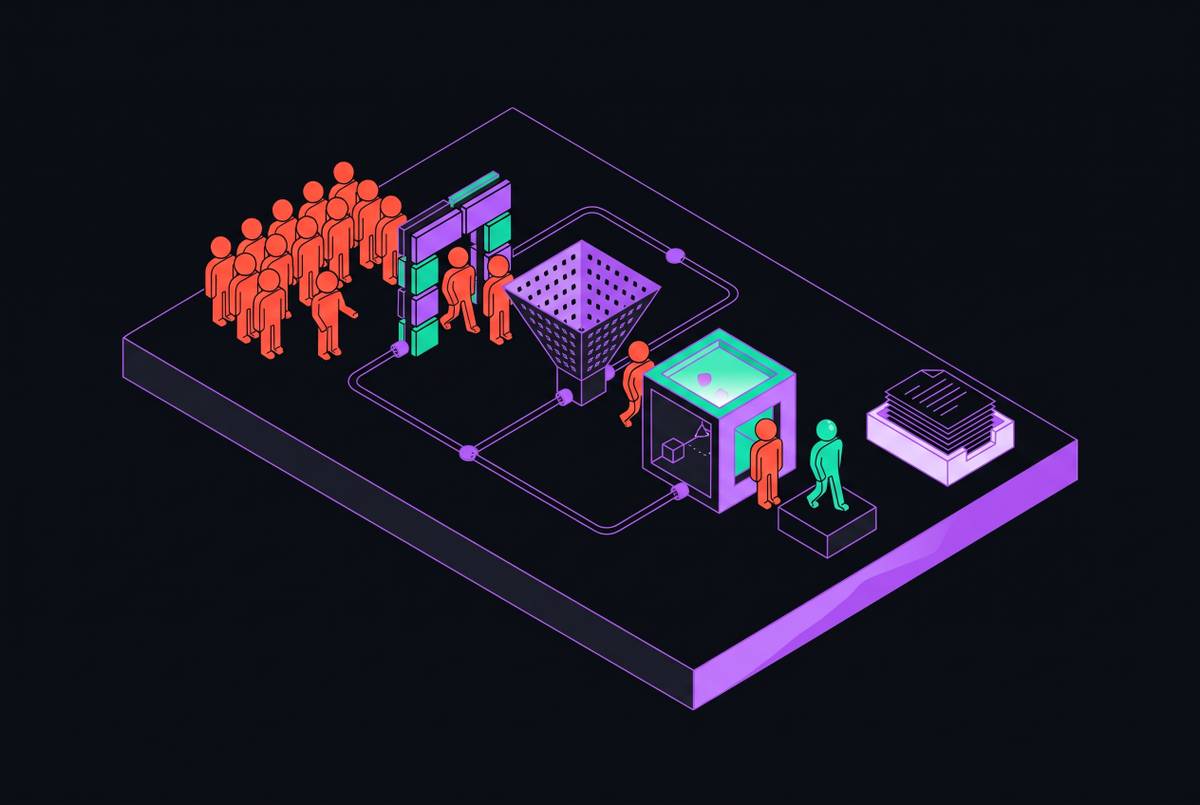
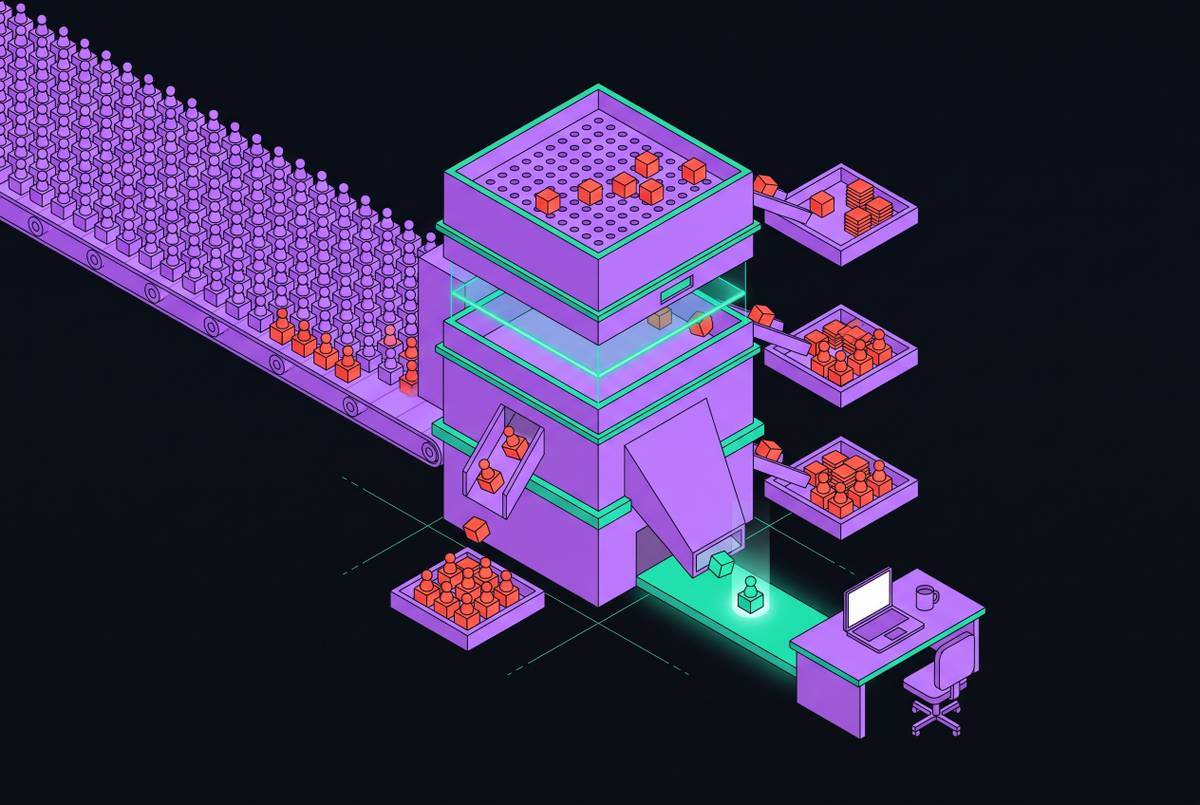
Candidate drop-off at AI startups spikes after the first interview when opaque AI screening is followed by withheld compensation. Fast engineering hiring depends on closing both trust gaps, with clear AI disclosure, an upfront salary range, and a clear account of what happens next. Publishing real salary bids before the second round keeps compatible candidates invested and moves pay mismatches out of the process before either side wastes more time.
Why post-first-interview drop-off is a trust problem, not a volume problem
A candidate who leaves an AI screen before recording an answer registers as a non-response even when they rejected the process. The team sees that few people finish and assumes it needs more applicants. That diagnosis sends more people through the same obstacle. The dashboard records the loss without explaining its cause.
The confusion grows after the first interview, when the company believes engagement is established. These candidates applied, read the job description, and cleared an initial screen. Strong engineers with several active conversations can leave the process that asks the most while revealing the least. A demanding format can thus favor people willing to put up with uncertainty over those with stronger engineering skills.
For a Series A startup hiring a small cohort, each departure removes a meaningful part of an already narrow pipeline. More sourcing does not repair the reason those people leave. Trust breaks down in two stages: opaque screening uses up some of the candidates’ trust, and withheld compensation uses up what is left.
How opaque AI screening erodes candidate trust before the second round begins
AI involvement alone does not explain the abandonment. Candidates are reacting to systems that are undisclosed and unaccountable, especially when nobody appears responsible for the outcome. The process asks candidates to submit to evaluation without showing who evaluates them, what gets measured, or where human judgment enters.
Greenhouse’s 2026 Candidate AI Interview Report identifies pre-recorded video graded by AI with no human present as the leading abandonment trigger, cited by roughly a third of candidates who abandoned. The format removes reciprocity from the exchange. A live conversation gives candidates someone to question and creates an obligation to respond. A recording asks them to put in effort without the same promise of a response. It costs the employer less to screen people, but it also becomes easier to ignore them.
Surprise makes that imbalance harder to accept. The report found that a large majority of candidates who went through an AI interview were not clearly informed upfront, with a significant share discovering the involvement only after the interview started. That is not simply a preference about interview format. It changes the terms of participation after the candidate has already agreed to take part. Gartner’s Q1 2025 candidate survey found that most candidates did not trust AI to evaluate them fairly and feared that a model would incorrectly fail their application.
Engineers have a particular reason to scrutinize the design. Senior engineers who have shipped LLM systems can recognize repeated questions, missing follow-up, and hallucinated summaries as signs of a poor screen. Those defects can undermine confidence in both the employer’s judgment and its hiring software. Yet the company may still see completed evaluations and a functioning workflow. From inside, the tool looks productive, while the candidates best equipped to judge it may already have left.
How withheld compensation turns surviving candidates into dropouts
The candidate who stays has not necessarily regained trust. A compelling role may have persuaded an engineer to tolerate a poor screen, but that tolerance is not an unlimited commitment. After the first interview, the next request is usually for more time. Without compensation information, the engineer must decide whether to spend it on an outcome that remains financially unknowable.
Reluctance to apply without a posted pay range is a well-established pattern. Candidates who proceed anyway are already a more tolerant group, willing to learn enough about the role before ruling it out. That concession has a limit. When no number appears after the first round, continued participation becomes a gamble. An engineer with other conversations underway has a rational reason to favor the offer they can assess.
When no one responds after the screen, that gamble gets worse. The Greenhouse report found that a majority of candidates who completed an AI interview received no result, with 38% ghosted entirely and others still waiting. The employer has asked for information without returning a decision. Withholding pay then repeats the imbalance at the next stage, asking candidates to reveal more about their skills while revealing little about what the company will give in return.
Equity can deepen the uncertainty. If an engineer cannot calculate the realistic value of a stock option package, they cannot compare the total offer with a competing one. The larger, safer offer becomes easier to choose because it is legible. This is why the two trust gaps compound. A candidate who gave an opaque screen the benefit of the doubt may refuse to make another exception when compensation remains hidden.
What the regulatory environment now requires from AI startups regardless of size
The regulatory shift in 2026 turns parts of this design problem into legal obligations. Pay transparency and AI hiring disclosure are no longer only ways to improve candidate experience. Which rules apply depends on the jurisdiction and how the company hires. Small size, however, is not a general exemption, and waiting until the second round can already be too late for required pay disclosure.
The EU Pay Transparency Directive set June 7, 2026, as the member-state transposition deadline. Its salary range disclosure and salary history provisions apply regardless of employer size, unlike gender pay gap reporting duties, which are phased in by size and exclude smaller employers below the Directive’s baseline threshold. A ten-person startup with an EU-based hire must provide the salary range in the job posting or before the first interview and cannot ask salary history questions. The distinction is important for small teams.
California SB 642’s 2026 update defines “pay scale” as the actual expected range at hire, making broad placeholder ranges non-compliant. As of July 2026, seventeen U.S. states plus D.C. require pay range disclosure. California, New York, and Illinois have pay transparency laws in force that require ranges in job postings, so startups hiring senior engineers face these rules directly.
The EU AI Act and hiring rules in Illinois, New York City, and Colorado, whose rules take effect Jan. 1, 2027, establish transparency requirements around automated hiring decisions. These are distinct legal regimes, including a city law in New York City. The practical direction is nevertheless aligned with candidates’ demands. Clear AI disclosure and real pay information help employers follow the law and give people reason to trust how they hire.
Why publishing salary bids before the second round reverses the attrition curve
A real salary range changes the decision just when uncertainty is most likely to end the conversation. Before a second-round interview, the candidate can judge whether the possible pay is worth more of their time. The role no longer has to survive on enthusiasm alone. Where disclosure is required earlier, the range belongs in the posting or before the first interview.
The efficiency gain runs in both directions. Candidates whose expectations sit outside the range can leave before a final-round offer mismatch wastes more time. Candidates within the range have a concrete reason to stay engaged because the employer has answered a basic question without making them earn the answer. The remaining pipeline is better aligned on pay.
For pre-seed and seed startups, the range needs an understandable equity outline. A company that cannot match frontier-lab base salaries still needs candidates to assess its full proposition. Explaining the package gives engineers a basis for comparing the startup with a safer offer, while leaving them free to decide that the trade-off is not right.
Pay transparency also offers a partial repair to the earlier trust damage. A company that openly states what it can pay signals a willingness to make the process accountable. That signal is useful, but it has limits. Publishing a range reduces the uncertainty left by the screen while direct disclosure explains how candidates are evaluated.
Founders have good reasons to worry about room to negotiate, internal pay compression, and revealing how little they have to spend. A range preserves flexibility that a single number would not, while an honest upper bound helps candidates decide whether further negotiation is worth pursuing. It does not erase internal pay conflicts. But concealing the range only postpones a mismatch with candidates who need more than the company can offer.
What a trust-first screening process looks like in practice for an AI startup
For a startup trying to hire engineers quickly, changing the sequence of information takes priority. Start with the invitation to the AI screen. State which part involves AI, what it evaluates, and that a human reviews the output before a decision. The process must actually include that review. Disclosure works only when it describes how hiring operates.
Next, put compensation before further investment. Publish the real salary range upfront where required, and otherwise provide it no later than the invitation to the second round, with the equity outline. This gives the candidate enough information to accept the next conversation knowingly and identify before investing several rounds whether the company can meet their needs.
Timeline transparency belongs in the same exchange. After submitting work or recording answers, the candidate needs a clear account of the next step. Close the loop on every screened candidate, including those who will not advance. A rejection still shows that someone took responsibility for the decision. Silence encourages the same disengagement employers complain about and can damage reputation in a tightly connected senior engineering pool.
The second round should then match the job on offer. A founder-led conversation about building from scratch followed by a generic LeetCode round sends conflicting signals about what the company values. For founding engineer and early-stage ML roles, the evaluation itself should show engineering judgment. Otherwise, transparent compensation gets candidates to the next stage only for a poorly matched assessment to undermine their confidence again.
Platform selection should follow those same criteria. Curated matching platforms that reveal salary and role details before first contact address the compensation gap earlier than processes that withhold numbers until candidates have invested time. Platforms should be compared on when candidates can see the range, understand the role, and decide whether to engage. With that information upfront, both sides can save the second round for a match that could work. That is where a faster hiring process earns its speed.