How Elite AI Startups Filter for Top-Tier Engineers Before the First Resume Review
Referrals, public work, and role-specific screens now come before resumes.
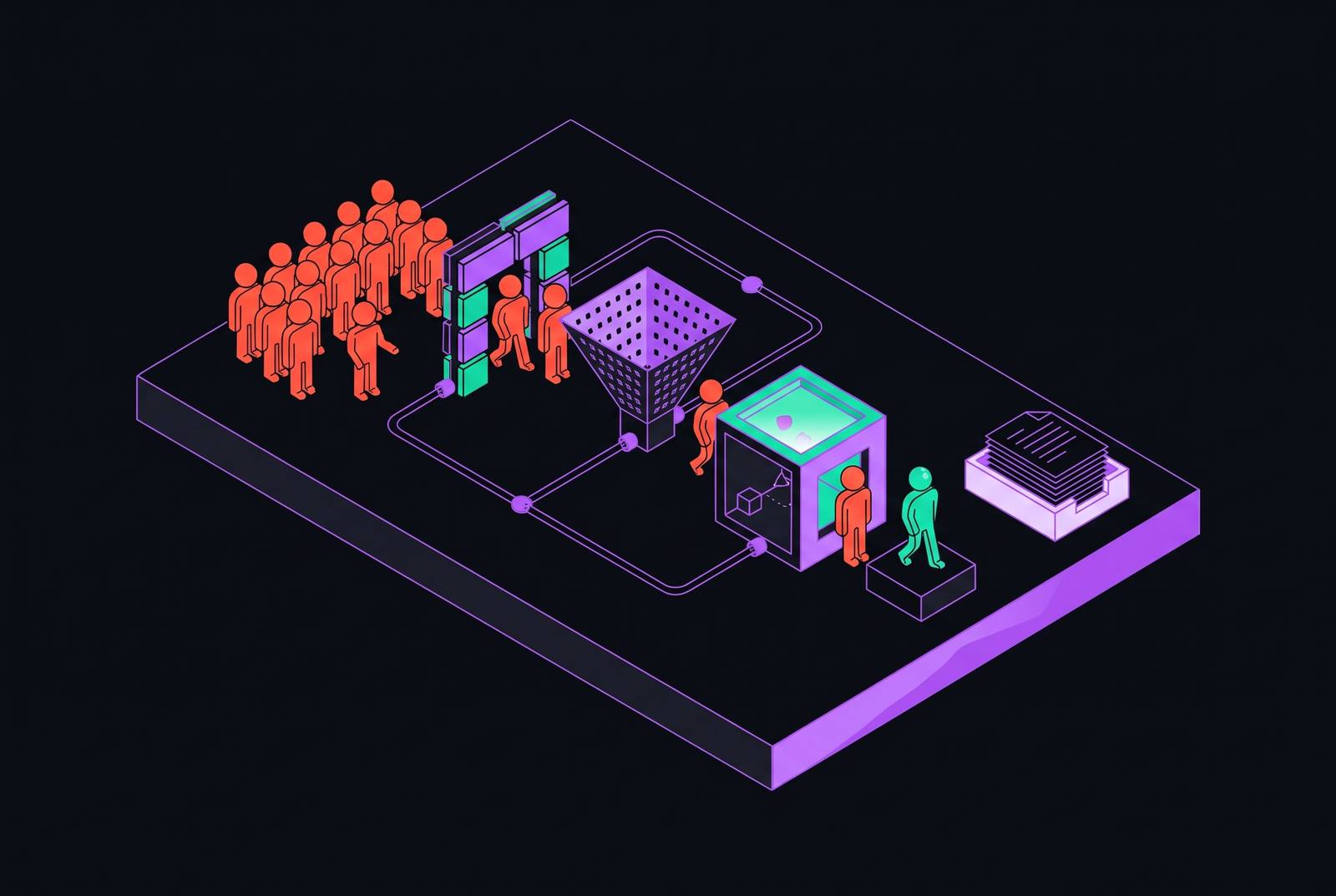
Elite AI startups find strong engineers through trusted referrals, verifiable public work, and role-specific screens before a resume gets serious attention. A curated talent marketplace for elite ML and software engineers joining AI startups is useful because it makes those matches early, based on work people have shipped. The decisive filter is whether someone has already done the hard work the company needs.
Why resumes stopped working as a first filter for AI engineering roles
AI-generated and AI-polished resumes make technical fluency easy to imitate. Candidates can present the same tools, project descriptions, and confident claims whether they have shipped a reliable system or only assembled a demo. The wording no longer separates those groups. A resume optimized to pass keyword filters tells a startup little about how its author handles production constraints.
The ambiguity sits inside familiar claims. “Trained an LLM” can blur fine-tuning with pretraining, while “built an agent” says nothing about what happens when it fails. A “prompt engineer” may have no eval rigor, and a project description without inference cost leaves its commercial viability unexplained. Those gaps concern the work that separates a convincing demonstration from a useful product.
The applicant pool compounds the problem because strong senior candidates often enter searches through passive sourcing. Startups waiting for applications are not simply reading weak signals. They may never encounter the engineers they most want.
How candidate fraud raises the stakes for pre-resume filtering
Weak evidence is more dangerous when applicants change it on purpose to mislead. Checkr’s 2025 Hiring Hoax survey found that most hiring managers suspected candidates of using AI to misrepresent themselves, and nearly a third reported interviewing someone using a fake identity. Those suspicions alone do not prove that cheating is widespread. But the findings help explain why hiring teams no longer trust an application just because it looks impressive.
Bots, deepfakes, and live AI coaching extend that uncertainty beyond the written application. Engineering hiring managers also report AI-assisted cheating in technical interviews, so moving directly from a resume to a conventional screen does not necessarily resolve it. Gartner predicts that by 2028 one in four candidate profiles worldwide will be fake.
The practical distinction is between claims generated for an application and evidence that predates it. A formatted resume, cover letter, or one-way video answer can exist without the applicant having done the claimed work. A sustained public contribution history is harder to manufacture in real time. Trusted referrals add another source of accountability. These signals therefore increasingly sit before the resume review.
Network provenance as the first real filter — how referrals actually work at elite startups
Many staff and principal searches are referral-only in practice even when a public posting exists. Candidates may already be reaching the team through practitioner communities, former colleagues, and trusted referral chains before an inbound applicant receives a response. This is a deliberate sourcing filter.
Network provenance means who vouches for someone, where that person worked, and in what capacity they know the candidate. A staff engineer at a respected AI lab offers a different signal from a generalist recruiter. The useful distinction is how closely the endorsement connects to the technical work being assessed.
Community participation can supply a less formal version of that evidence. Consistent participation in a Hugging Face Discord, contributions to a LangChain repo, or a recognizable handle in AI research circles can make an engineer known as a practitioner before a search begins. That differs from listing the same tools on a resume.
This approach risks reproducing existing networks and excluding qualified outsiders. A referral cannot be the whole test. The strongest counterweight is artifact verification, which lets work support a referral or give an engineer without one another route into consideration.
What public artifacts actually tell a startup before a resume arrives
GitHub contributions, ArXiv pre-prints, Kaggle rankings, and open-source commit history each reveal different kinds of ability. They are not interchangeable badges of technical strength. Their value depends on what the work demonstrates and what the role requires.
On GitHub, green squares are less revealing than the contributions behind them. Work on production-grade libraries such as Transformers shows experience navigating a complex, collaborative codebase. A merged PR is a specific piece of work a team can check. A deployed system with documented evals adds evidence about how its author measures whether the system works.
Research and competition records answer different questions. ArXiv pre-prints can signal that an engineer contributes to research rather than only consuming it, making them useful sourcing signals for research-adjacent roles. Kaggle rankings show how well someone can optimize for a set goal. They do not establish production experience, so a high rank without shipped systems remains a partial signal.
Absences also shape the reading of public work. Projects with no eval datasets, failure-mode documentation, or discussion of inference cost leave production judgment unproven. Those absences make a polished portfolio weaker evidence than sustained work under visible constraints.
Why role confusion between AI engineer, ML engineer, and research scientist creates a filtering failure before any screen begins
Artifact review fails when the company reads good evidence against the wrong job. An AI engineer turns existing models into useful products. An ML engineer makes machine-learning systems reliable and scalable in production, while a research scientist creates or validates new methods. Those distinctions change which artifacts deserve attention.
Many Series A and B AI startups need a research engineer who can advance research and ship. A foundation model company may have a different requirement because research output can itself be central to the product. The title alone cannot settle that distinction. The filter has to reflect the work blocking the business.
Consider the failure pattern of a startup hiring a researcher while its product team waits for production improvements. Papers appear, the research is novel, and the roadmap still slips. An ML engineer may then deliver the improvements the product needed. The earlier hire was evaluated for a different contribution.
Converging roles make this harder to diagnose. Research scientists code at scale and think about how to deploy their work, while research and ML engineers co-author papers. Yet a posting that stresses how many papers someone has published and which conferences they have appeared at still draws signs of prestige. It can reject the right hybrid engineer because their strongest evidence looks wrong for the role as written.
How founding engineer hiring exposes the limits of every standard pre-screen
Founding engineers need judgment under constraint. A strong public record can justify a conversation, but it cannot fully show how someone will choose an architecture for this company’s actual problem.
The candidate is filtering the company too. Is the work a genuinely hard AI problem or a wrapper around GPT-4? Do the founders understand what they are building, and will the engineer be building the product or building processes to build it? Those questions affect whether the interview happens at all.
LeetCode-style challenges fit this decision poorly because algorithm recall and competitive programming do not reveal the required judgment. The more useful screen presents the actual AI problem and asks for a proof-of-concept architecture. They discuss the RAG design, how to measure quality, the eval dataset, and the cost per query.
An engineer who cannot design evaluation infrastructure risks producing a system that works in demos and fails in production. This makes the architecture discussion an extension of artifact review, now applied to the company’s own constraints. Production AI experience also pays more than lab experience, and founding-level packages include a meaningful share of equity. A conventional screen cannot substitute for assessing what earns that premium.
How AI-conducted first rounds changed what "pre-resume filtering" even means
The system can ask follow-up questions, score answers against a rubric, and recommend a candidate before a person opens the file. The first interview is now sometimes the upstream filter. “Pre-resume” therefore describes the order of human review.
The format changes what evidence the candidate leaves. In asynchronous scored video, there are no follow-ups and one take becomes the full record. Live conversational AI can interrupt and probe, with some systems detecting tab-switching as a cheating signal. AI-native marketplace screens extend the effect further because the score follows the candidate across clients.
These differences make “AI interview” an incomplete description of the process. A recorded answer and a probing conversation do not offer the same chance to explain technical judgment. A reusable marketplace score also reaches beyond one hiring decision. Engineers need to know which kind of screen they are entering.
Adoption introduces a selection effect of its own. Some candidates complete these interviews and receive only silence, while others consider an AI first round a dealbreaker. The system filters willingness to participate as well as answers. Human review remains important because unexplained automated rejection creates bias and compliance risks.
What engineers misunderstand about how their candidacy is actually evaluated before they hear anything
Many engineers prepare for the human interview as though it remains the first consequential decision. By then, earlier signals may already have determined access. Who surfaced the candidate, what public work exists, and how that experience fits the actual need can decide whether a conversation happens.
An application followed by an unnamed AI interview link makes that process difficult to read. Silence afterward reveals little about which filter failed. The candidate may think the resume needed better wording when the company was looking for proof of production work or a different kind of engineer. A misdefined role makes that uncertainty worse.
For engineers navigating a search, the practical lesson is to build evidence before applying. That means a public record that withstands technical review, a presence in relevant practitioner communities, and connections to the networks where startups source. School pedigree and company brand cannot demonstrate the specific hard thing a team needs done. Work can.
Curated talent marketplaces serve this gap when they match candidates through verified work and provenance. The useful comparison is what has been assessed and how closely it fits the role. Interview requests with salary bids upfront also let engineers evaluate an opportunity earlier. That respects the speed at which strong candidates leave open searches.
What elite startups that get this right actually do differently at each stage of the upstream funnel
A well-designed upstream funnel starts with practitioner communities and trusted referral chains before a public posting. That makes the pipeline warm before first contact. Artifact review then tests the referral against production evidence, including merged PRs, eval infrastructure, and documented failure modes. Recognizable tool names are not enough.
Role-fit alignment determines how that evidence is used. The team distinguishes between an AI engineer, an ML engineer, and a research engineer before designing the screen, rather than allowing an attractive title to define the search. This prevents a publication-heavy filter from displacing shipping evidence. It also avoids asking candidates to prove abilities the job does not need.
In a sandboxed problem, an agent might be looping, overspending, or producing malformed outputs, and the assessment focuses on the candidate’s mental model of the failure. Founding candidates instead discuss an architecture for the actual AI problem, including eval design.
People still review candidates even when AI helps score them. When a system rejects candidates on its own without scoring it can explain, it risks bias and may break laws in force in New York City, Illinois, and California.
The funnel has to move fast because the best candidates leave open hiring processes within weeks. A compressed path from first contact to offer signals that the startup can make decisions. Earlier filters pay off only when the company acts on what they reveal before the engineer accepts another opportunity.